
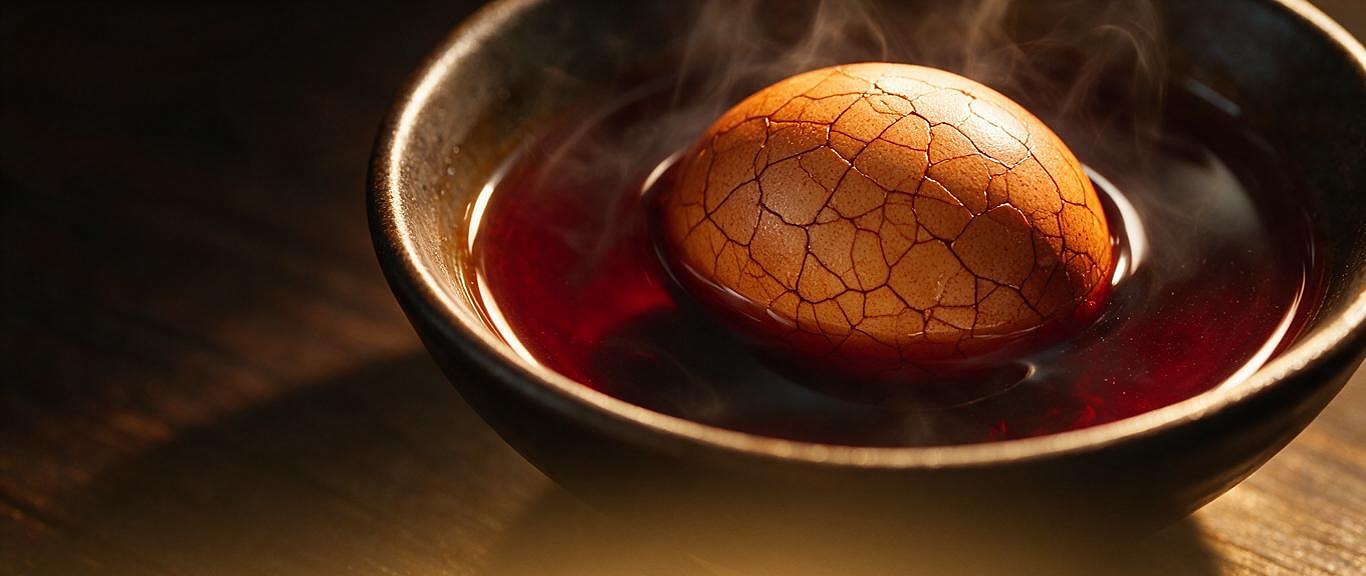
THE STATION · The Intelligent Fire
One machine
one prep room
one process
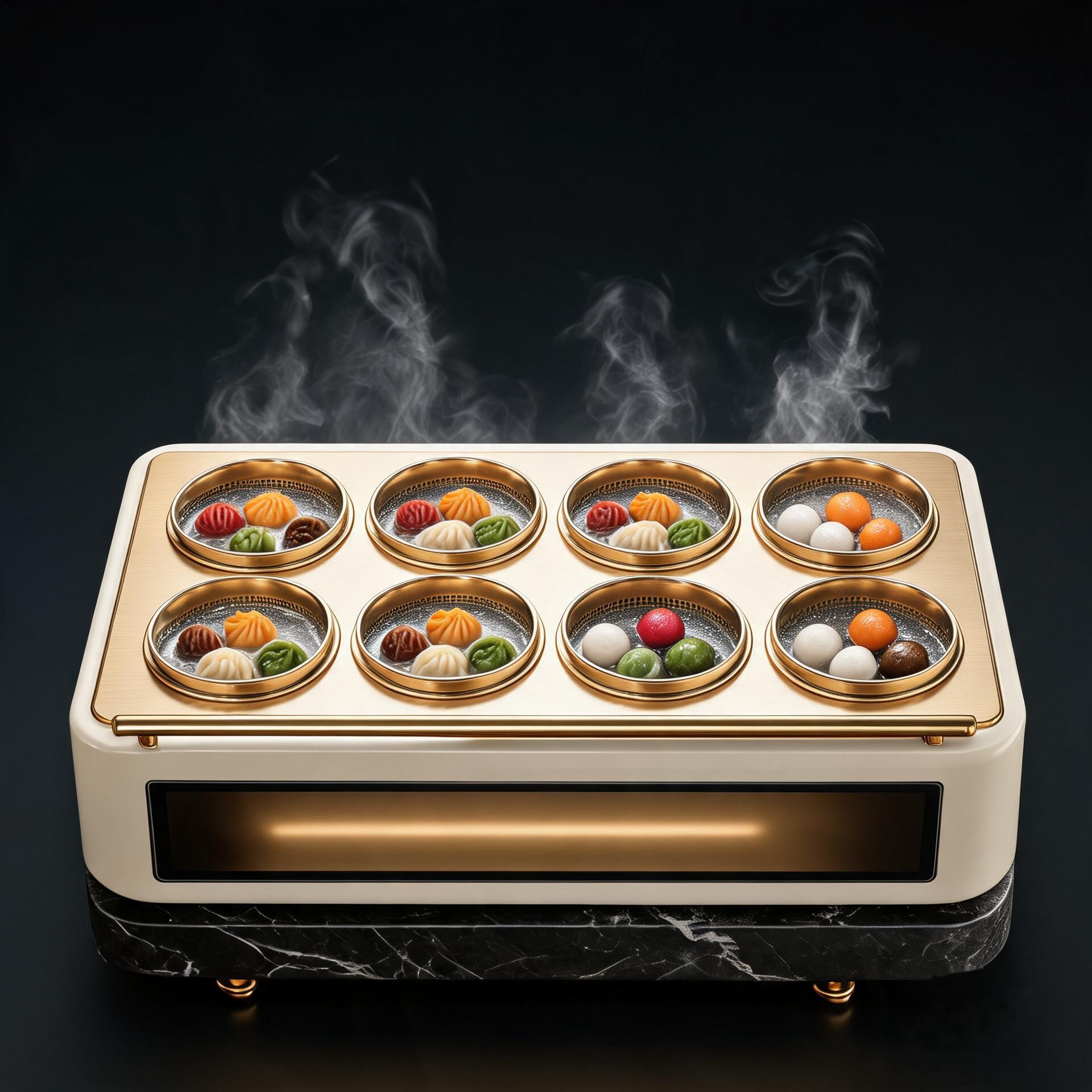
Eight pots boiling at once, each with its own timer and its own water temperature — the shop no longer leans on a master's hand, the food no longer leans on the day's form.
The machine is not for speed — it is for the same taste, every time
Eight pots
cooking as one
Twelve pieces to a pot at a time, eight pots working at once — no queue at the peak, no idle pot at the lull.
- Eight independent potsIndependent
Each pot keeps its own time and its own temperature; one pot cooks one thing only — dumplings and tangyuan never trade flavours. The flagship carries sixteen.
- One-touch presetsPreset
Dumplings, tangyuan and zongzi each carry their own time and fire. Press once and walk away — no watching the clock, no counting seconds.
- Side-draft steam extractionSide Draft
A negative-pressure intake along the back of the pot rim pulls steam sideways instead of upward — no steam in the face, no damp walls, no film on the lamps.
- Held warm, ready to goKeep Warm
Kept at 65℃ until it is called for — for whoever comes home late, a portion is always waiting.
- Built like an objectBody
Enamel body, brass pot rim, black glass panel — scrubbed and heated daily, and under one lamp it never looks greasy.
Three boils, three additions
two lines of drainage
The two things that matter most in boiling dumplings — the cold-water splash and the water change — belong to neither a hand nor a tap.
I
At the boil, add water
The instant the surface hits 100℃ and the roll threatens to split the skins, 8℃ clean water falls from the ring seam at the rim — the surface settles back to 92℃, skins tighten, fillings keep cooking through. Three rounds: 1.5 L → 1.2 L → 0.8 L.
II
Two drain lines, one clear pot
Main drain at the base: 15 seconds after each round, 9.5 L empties out and fresh water returns to 6.0 L. Overflow at the rim: water only leaves this way past 10.0 L — anti-flood, and a second safeguard.
III
The outlet you never see
No tap. Water falls from a fine ring seam inside the rim and runs a circle along the wall of the pot — like dew, not pipework. Look up and there is only a ring of brass.
Note One full water cycle: dumplings into boiling water (6.0 L) → first boil, +1.5 L → second boil, +1.2 L → third boil, +0.8 L (full at 9.5 L) → after serving, main drain 9.5 L and fresh water back to 6.0 L; overflow line 10.0 L, low-water auto stop at 4.0 L. Temperatures, volumes and drain thresholds are planned parameters, adjustable by category; final values follow the released equipment and the shop SOP manual.
Behind the counter
a 2.4-metre workflow
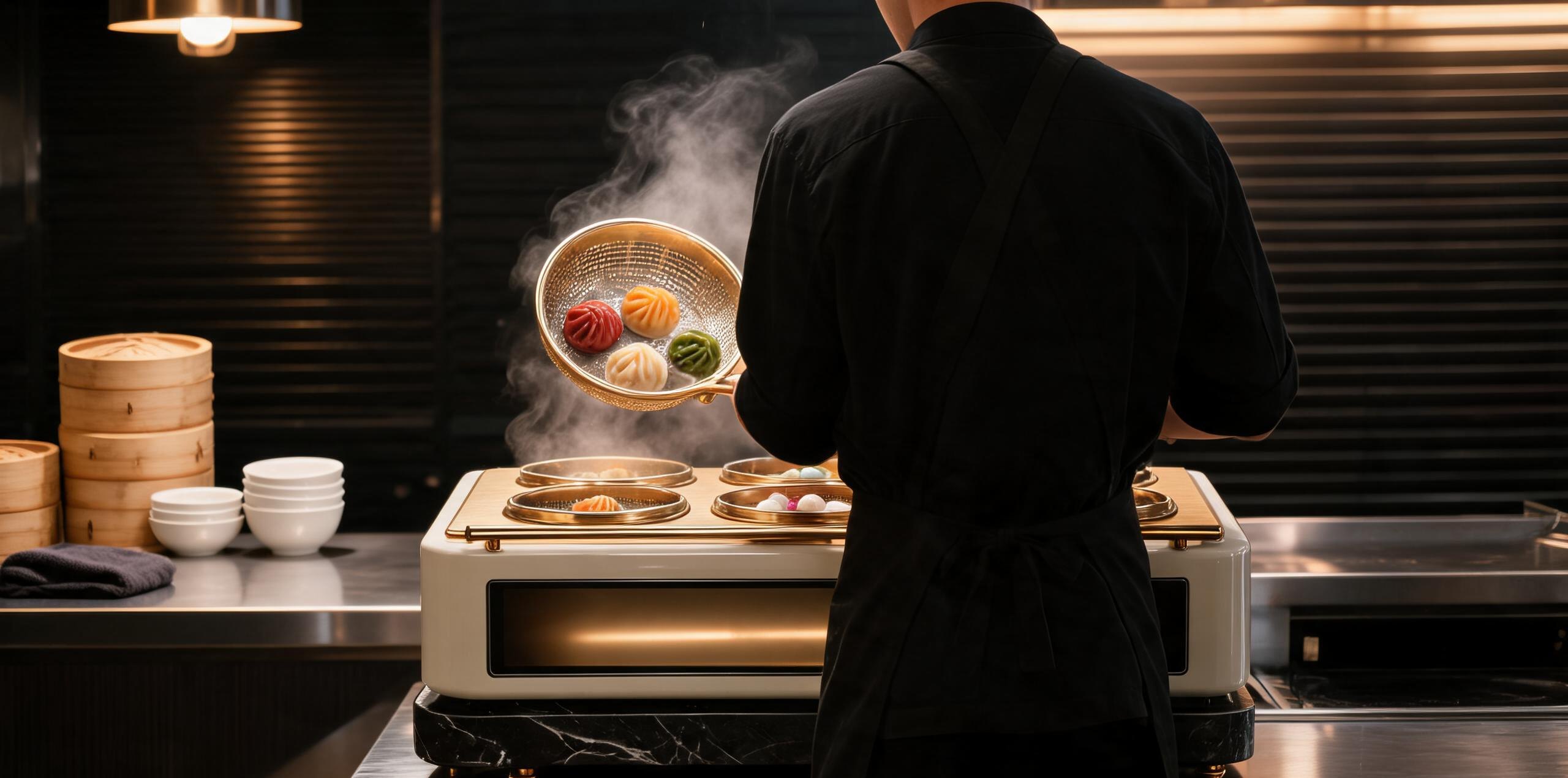
No back kitchen, no open flame — one worktop, one machine, one person.
- Space claimedFootprint
One machine; worktop depth 60 cm; clear width behind the counter no less than 1.2 m.
- Water & powerUtilities
220V single-phase with its own leakage protection; water in and out, and a floor drain, close at hand — reserved in one pass during fit-out.
- Side-draft steam extractionSide Draft
The machine's own side negative-pressure intake carries steam away sideways at the rim — no big hood overhead to install, and no one at the bar gets smoked.
- Cold storage at handCold Storage
Chest below, upright against the wall, three drawers in between — stock taken and cooked on the spot. Goods never touch the floor, never leave the temperature zone.
| Interface | Specification | Installation |
|---|---|---|
| Water inlet | DN20 · 0.15–0.4 MPa · 5–35℃ · ≥25 L/min | Independent valve + 5 μm pre-filter; hardness ≤200 mg/L (as CaCO₃) |
| Splash pre-chill | Outlet 8℃ ±1℃ · 1.5 L chilled tank | Internal-cycle refrigeration, no external cold source |
| Drainage | Main DN40 · overflow DN25 | Outlet centre 80–120 mm above floor · slope ≥2% · connect nearby to a DN50 floor drain |
| Power supply | S8 220V single-phase 32A · S12 220V 40A · F16 380V three-phase 25A | Independent breaker · 3×6 mm² or 5×4 mm² copper line · 30 mA RCD · earthing ≤4 Ω |
| Environment | 5–40℃ · humidity ≤85% | Worktop load ≥200 kg · 10 cm clearance all round for heat |
Three ways to place them
one temperature
The chest lies below the counter, the upright stands against the wall, the drawers sit between them — one portion taken without a detour, without a stoop.
-
ILying low · chest freezer
Chest Freezer
Tucked below the worktop, lid lifted for access. About 1.2 m long, 0.6 m deep, 0.9 m high — the counter stays unbroken, and no extra step is claimed behind it.
-
IIDrawers · loose & boxed
Drawer Stack
Three drawers set between freezer and worktop: loose bags below, boxed gifts in the middle, dip dishes and consumables on top — pull, take, no crouching through boxes.
-
IIIStanding · upright freezer
Upright Freezer
Against the wall, glass doors facing inward. Frozen at -18℃ above, chilled at 0–4℃ below — customers can see the stock, staff can see the inventory.
- Temperature zonesZones
Frozen below -18℃ for tea dumplings, tangyuan and zongzi; chilled 0–4℃ for the day's thaw and the dipping sauces.
- Kept apartSeparation
Raw from cooked, loose from boxed, the five colours in their own compartments — no flavour trades inside a freezer, no bag crushed beneath another.
- LabelledLabels
One label per slot: name, batch, date in. New bag, new label — nothing unclear leaves the freezer.
- RestockReplenish
First in, first out, front row out first. Temperature checked and logged at opening each day; stock counted at close.
| Drawer | What it holds | Rule of use |
|---|---|---|
| Top · consumables | Dip dishes, takeaway bags, single-use tableware | Refill to full, no surplus stacked |
| Middle · boxed | Gift boxes, souvenirs, seasonal packs | Facing set by the season, first in first out |
| Bottom · loose | Bagged tea dumplings, tangyuan, zongzi, tea eggs | Taken by the whole bag, replaced as soon as empty |
THE UNDER-COUNTER · Sixteen pots, one cabinet
The freezer sits under your hands
F16-C builds the -18℃ chest into the cabinet: cooking surface at 900 mm, and 430 mm below it the freezer bay, twin pull-out baskets left and right facing the working position — take stock standing, drop it in with a lift of the hand. No turning, no crouching. S8 / S12 can carry the under-counter freezer too.
- Bay capacityCapacity
About 320 L · twin pull-out baskets, left and right · -18℃ ±2℃
- Pick-up pointAccess
Facing the working position · pull-out travel 480 mm · 40 kg load per basket
- DefrostingDefrost
Manual, once a week, about 5 minutes each time; drainage joins the main drain line
Note Freezer layout, drawer tiers and integral-cabinet dimensions are planned shop configurations; figures are indicative. Actual values follow the shop drawings, the released equipment and the shop SOP manual.
Three water additions
not one of them spare
The craft of boiling dumplings comes down to one sentence: skin and filling arrive in the same second. What the machine does is break that sentence into six repeatable moves.
I
Into boiling water
The basket drops at 100℃; the starch on the skins gelatinises and sets within thirty seconds. Dropped in before the boil, the skin falls apart first and the filling cooks late — the bowl is ruined.
II
First boil, add water
Surface at 92℃. The skin contracts sharply, the thick edges set first, the filling begins to heat through; without this addition, the skin turns to mush ahead of the filling.
III
Second boil, add water
Pressed down to 90℃. The temperature gap is pressed once more, so thin edges and thick edges arrive together — the five colours have skins of different thickness, and this is the hand that levels them.
IV
Third boil, add water
Back to 92℃ and the skins lock: protein sets, starch seals into a thin film — out of the pot without sagging, without sticking, without breaking.
V
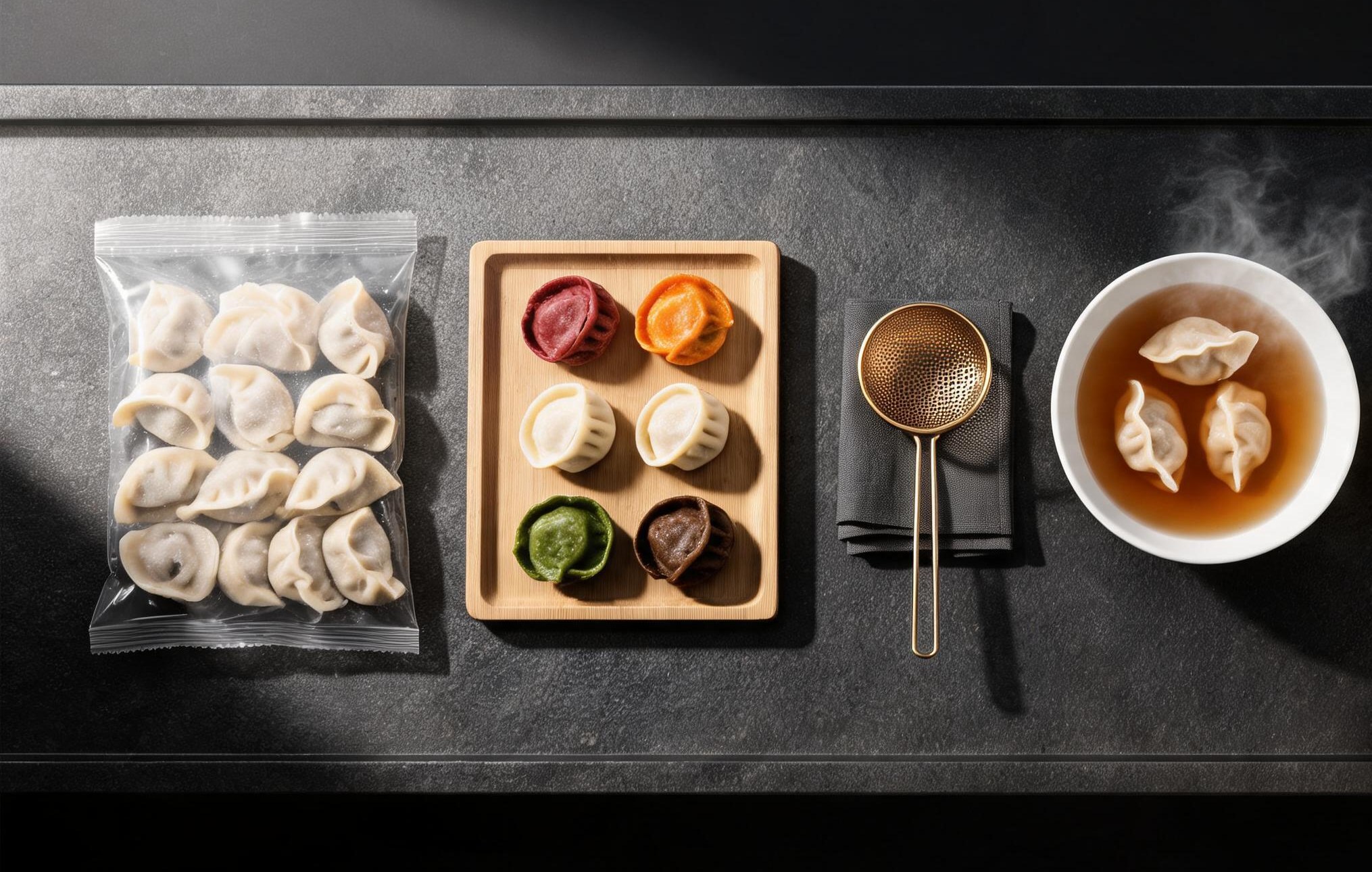
Straight from the freezer, never thawed
From the -18℃ freezer straight into the pot. Ice crystals stay inside, skins neither turn stale nor drink the broth — thaw first, and the skin will always slump.
VI
Drain, then pour the broth
The basket drains for 8 seconds; 60 ml of rock tea broth goes into the bowl first, dumplings after. Skins don't soak, and ten minutes on the table they still hold.
| Stage | Time | Action | Temp · Water level |
|---|---|---|---|
| Into the pot | 00:00 | Basket down into boiling water, twelve to a pot | 100℃ · 6.0 L |
| First boil | 00:50 | +1.5 L (8℃ clean water) | 92℃ · 7.5 L |
| Second boil | 02:10 | +1.2 L (8℃ clean water) | 90℃ · 8.7 L |
| Third boil | 03:40 | +0.8 L · the skins lock | 92℃ · 9.5 L |
| Out | 05:30 | Basket lifted, drained 8 seconds; into the bowl, broth poured | 92℃ · 9.5 L |
| Reset | 05:45 | Main drain 9.5 L, fresh water back to 6.0 L | 25℃ · 6.0 L |
Note The table shows planned timing for dumplings (5 min 30 s); one tangyuan round runs 4 min 00 s — first boil 0:45 (+1.0 L) · second boil 1:40 (+0.8 L) · third boil 2:35 (+0.6 L) · out at 4:00. Times, volumes and temperatures are planned parameters, adjustable by category and by shop altitude; final values follow the released equipment and the shop SOP manual.
Six steps
whoever cooks, the same taste
From bag to reset, six steps fixed — change the person, the shop, the city, and the bowl that comes out is still the same.
| Step | Action | Parameter | Result |
|---|---|---|---|
| 01 Take stock | Bag from the freezer, unsealed — no thawing, no washing | Bag temp ≤ -18℃ | Never leaves the cold zone |
| 02 Count | Twelve to a pot, five colours in their places | 12 pcs / pot | Portions match |
| 03 Into the pot | Basket down after the boil — no overlap, no crowding | Into boiling water | Skins unbroken, unstuck |
| 04 Timer | Preset chosen by product, machine keeps time; water added three times at the boil | Dumplings 5'30" / tangyuan 4'00" (±10 s) · 3 water additions | Same fire, skins intact |
| 05 Serve | Basket drained, bowl filled with broth, five dishes out together | On the table within 90 s | Steam intact, dips complete |
| 06 Reset | Basket cleaned, counter wiped, waste logged; main drain and refill run on their own | One round ≤ 3 min | The next round starts from fresh water |
Note Times and temperatures above are planned standard values; final values follow the released equipment and the shop SOP manual.
One person
can hold one counter
Once the machine takes over the fire, three things remain: stock, serving, cleaning.
In a small shop, eight pots watched by one, sixteen rotated by two — one person's craft is no longer the risk. The steadiness of the machine is the ground under it.
Seven models
the same standard
From the home four-basket to the flagship sixteen pots, one water line, one fire, one set of timings — only the pot count, the power and the cabinet change.
| Model | Use | Pots · Output per round | Dimensions mm | Power | Supply |
|---|---|---|---|---|---|
| D4 | Home · countertop | 4 baskets × 6 pcs · 24 pcs | 520 × 420 × 260 | 2.2 kW | 220V 16A |
| O2 | Office · double-burner tea table | 4 baskets + 1 tea burner · 24 pcs | 1200 × 600 × 750 | 3.6 kW | 220V 20A |
| S8 | Shop · standard counter | 8 pots × 12 pcs · 96 pcs | 1600 × 600 × 850 | 4.8 kW | 220V 32A |
| S8-C | Shop · with under-counter freezer | 8 pots × 12 pcs · 96 pcs | 1600 × 600 × 900 | 4.8 kW | 220V 32A |
| S12 | Shop · wide | 12 pots × 12 pcs · 144 pcs | 2000 × 600 × 850 | 7.2 kW | 220V 40A |
| F16 | Flagship · central counter | 16 pots × 12 pcs · 192 pcs | 1600 × 1200 × 850 | 9.6 kW | 380V three-phase 25A |
| F16-C | Flagship · with under-counter freezer | 16 pots × 12 pcs · 192 pcs | 1600 × 1200 × 900 | 9.6 kW | 380V three-phase 25A |
The -C suffix marks the version with under-counter -18℃ freezer; D4 / O2 are home and office models in planning — specifications subject to the official release.
| Item | Shop S8 | Flagship F16 |
|---|---|---|
| Pots | 8 independent | 16 independent |
| Per pot | 12 pcs | 12 pcs |
| Per round | 96 pcs | 192 pcs |
| Water per pot | 6.0 L (full 9.5 L · overflow 10.0 L) | 6.0 L (full 9.5 L · overflow 10.0 L) |
| Water per round | about 76 L | about 152 L |
| Rated power | about 4.8 kW | about 9.6 kW |
| Supply | 220V single-phase 32A | 380V three-phase 25A |
| Dimensions | 1600 × 600 × 850 mm | 1600 × 1200 × 850 mm |
| Counter depth | 600 mm | 1200 mm |
| Water addition | Automatic · three times, adjustable · 8℃ clean water | Automatic · three times, adjustable · 8℃ clean water |
| Drainage | Main DN40 + overflow DN25 | Main DN40 + overflow DN25 |
| Steam extraction | Side negative-pressure intake | Side negative-pressure intake |
| Timing accuracy | ±10 s | ±10 s |
| Keep-warm | 65℃ | 65℃ |
| Net weight | about 78 kg | about 132 kg |
One tea table
can still boil a pot
The same water line and the same fire, scaled down to four baskets and two burners — a pot after the meeting at the office, a bowl late at night at home.
I
Home D4
4 baskets × 6 pcs, 24 pcs a round. 2.2 kW / 220V 16A three-pin plug, 520 × 420 × 260 mm, 12 kg — it fits a kitchen counter.
10 L washable water tank, or plumbed straight to the tap; timer 0–12 hours, keep-warm 65℃, running at ≤45 dB.
II
Office O2
Two burners: the left boils dumplings, 4 baskets × 6 pcs; the right boils water for tea (85 / 95 / 100℃, three settings, 1.2 L).
Tea-table standard: 750 mm high · 1200 × 600 mm sintered-stone top · 3.6 kW / 220V 20A, a dedicated 4 mm² line recommended.
- Set the night beforeTimer
0–12 hours, error ≤1 minute; it drops the basket on its own — no standing watch.
- Remote controlRemote
Wi-Fi 2.4G; if the network drops, presets continue from local memory — it cooks without the cloud.
- Fully automatic water lineAuto Water
Three boils, three additions, two drains: four water-level judgements a round — no hoses attached, no lid lifted, start to finish.
- ProtectedSafety
Low-water shutdown · boil-dry protection · over-temperature cut-off · overflow protection · child lock · 30 mA leakage protection.
- Power drawPower
D4 2.2 kW (16A three-pin) · O2 3.6 kW (20A breaker, 4 mm² copper line).
- Setting upSetup
D4 sits on the counter, 10 cm clear all round; O2 stands on the floor, 5 cm from the wall for cabling, with an 8 L waste tank or a direct drain under the table.
Still being polished
released with the tea food
Until reliability and consistency are polished through, we are in no hurry to be seen — good equipment is like good tea food: before the fire is ready, the lid stays on
- Where it standsStatus
Still being polished — reliability and consistency brought all the way home, then we meet
- Planned settingsScenarios
Shop and home versions in planning, released with the tea food
- Reserve a demoReserve
Once prototype units arrive, invitations go out in order — service line and office address in the footer